Wednesday, 27 April 2011

Marriage with a liar (婚前試愛)

Marriage with a liar’ is a romantic film which written and directed by Patrick Kong. It released in the year-end of 2010. Before discussing the movie, I would like to talk about the director Patrick Kong first. In Hong Kong’s movie industry, the name of Patrick Kong can be said to represent ‘romance film’. It is because he had shot three successful romance films in previous years (Marriage With A Fool <獨家試愛>, Love Is Not All Around <十分愛> and L for Love, L for Lies <我的最愛>) and they aroused people’s attention. Thereafter, if we heard any movie which is shot by Patrick Kong, we will think of romance film immediately. Different from other local romance films, in Patrick Kong’s film, the relationships between the characters are always much more complicated. Cheating, lying and faithlessness are always become a main plot in his movies. Some people like Patrick Kong’s movie very much because they think his movie is much more realistic than other fairy-tale-ending romance film.

This movie talks about the clandestine love affairs of a groom-to-be and a bride-to-be before their wedding day. Before entering the cinema, I thought that it is another romance film talks about cheating and lying like the previous movies that Patrick Kong shot before. But this movie had surprised me since it revealed nowadays people’s attitudes towards marriage and this movie involved lots of stereotyping of the young people before marriage, especially men.

In the movie, Kiki (Chrissie Chou starring) had a single party before her wedding day. All of her friends persuade her to find a man to have fun before marriage. And the same situation happened to 阿澤 (Him Law starring) since his colleagues entice him to night club or else he would regret after marriage. This reflected the culture of ‘easy-come-easy-go relationship’. Also, the movie reflected that nowadays people have fear of marriage. People regarded marriage as the end of one’s single life freedom. In the film, the characters always emphasize some phrases like ‘marriage is the grave of love’.

Also, although the movie talks about the clandestine love affairs of both men and women, it involved lots of stereotypes of men. For example, the phrases that characters always repeat are ‘個個男人結婚前都出去玩’ and ‘十個男人九個滾, 剩低果個仲諗緊’. Also, in the film, all of the male characters are appeared as playboys. These phrases and images are mainly directed against male. In the movie, there are more details about how阿澤 has his clandestine love affair. Moreover, the man that Kiki met before wedding is also a groom to be. In my opinion, these created a sense that in the situation men are worst than women and women are more forgivable than men.

Although this movie seems bring out a realistic situation of nowadays people’s attitude toward marriage, the ending of this movie didn’t surprised me. The closure of movie is a wedding party. Like other romance film, this film ends by the characters having wedding party and at the end all the problems are solved. I think the director only stick to the traditional romance film formula to finish the movie. In my opinion, the ending just simply implied that marriage can solve the distrust and suspecting problem between couples and is a way for people to forgive the clandestine love affairs that happened before. It has some contradiction to its message since this movie is emphasizing the easy-come-easy-go relationship nowadays and people’s distrust of marriage.


By Wu Hiu Tung, Jodie (10380807)

I LOVE HK-我愛HK開心萬歲

Hello everyone, I would like to introduce a HK comedy movie, ‘I Love HK’ (我愛HK開心萬歲). This movie is shown during the Lunar New Year 2011. This movie is directed by Eric Tsang(曾志偉), and he is also one of the main characters in the film. Another main casts included Tony Leung(梁家輝), Sandra Ng(吳君如), Anita Yuen(袁詠儀) and Stanley Fung(馮淬帆) etc.

‘I Love Hong Kong’ is a story about a man, Shun Ng (吳順, casted by Tony Leung) and his family are forced to move back into the house estate to live with Ng’s father (casted by Stanley Fung) because Ng was bankrupt that his company and his toy factories are suffered from the financial tsunami. Although Ng had lived in the house estate during his childhood until he became an adult, Ng and his family are not really get used to the house estate life at the very first time after they moving back. However, Ng memorised his living in the house estate sometimes and he missed the old days very much. And after he met his old, closed friend, Tuo Shui Long (托水龍, casted by Eric Tsang), he started to recognized the current situation of his house estates. He knew that his community is facing a huge problem: the community stores are forced to close because of the invader- chain stores of the commercial corporation. Thus, Ng and the whole neighbourhood of the house estate decided to save and fight for the community together.


Firstly, I would like to share some producing background information of this film. The major investors of the movie are Shaw Brothers Studios (SBS) and Television Broadcasts Limited (TVB), and it is known that there is a intimated relationship between SBS and TVB since the major investor of the two company is Sir Shaw Run Run (*the shares changed in March 2011), so it is possible to say that, ‘I Love Hong Kong’ is a TVB production. From the movie, we can see that expect the main characters, the reminder actors and actresses are all from TVB! For example, Louis Yeun (阮兆祥), Bosco Wong (黃宗澤), Ron Ng (吳卓羲), Koni Lui (呂慧儀) and Wayne Lai (黎耀祥) etc. Thus, audiences will feel very familiar with the casting and it is also attractiveness for the TVB fans as well, it will attract them to buy tickets to support their idols! In addition, as I mentioned, this movie is kind of a TVB production. it is no doubt that TVB would use the film as a promotional tool for its image, artists, and the market. Therefore, that’s why Mag Lam (林欣彤) and Cho Lam Wong (王祖藍) took an essential role in the film: Mag as the daughter of Ng, Wong as Tuo Shui Long’s youth. Audiences can figure that two of them are the main focus of TVB, hence, TVB have to raise public attention on Mag and Wong through this film.


This movie definitely created collective memories for the Hong Kong generations who were born in the 60s and 70s, as the story is take place in a house estate, where lots of 60s and 70s hongkongers spent their childhood at. Thus, the whole movie may recall the 60s and 70s hongknogers’ childhood memories, and they may feel very familiar with those plots.


For another audiences who have never been through ‘the period of house estate’, the movie also emphasised the Hong Kong core value to raise those audiences’ familiarity. There are lots of plots represented Ng’s family sit down and having dinner together. Those scenes stated a important core value for Hongkongers : 一家人坐低食飯. You may found that those’ 一家人坐低食飯 ‘ scenes are very familiar, since all of us would have dinner with our family in daily lives. of course, it may not happen everyday, but it did happened, we talk about anything during that moment, even we just have a big fight with each other in the early of time, we finally forgot what has happened, we will just sit together and eat(talk), because we are family. So, from those scenes, it is clear to see that the movie is representing an essential Hong Kong core value: the meaning of being a family.


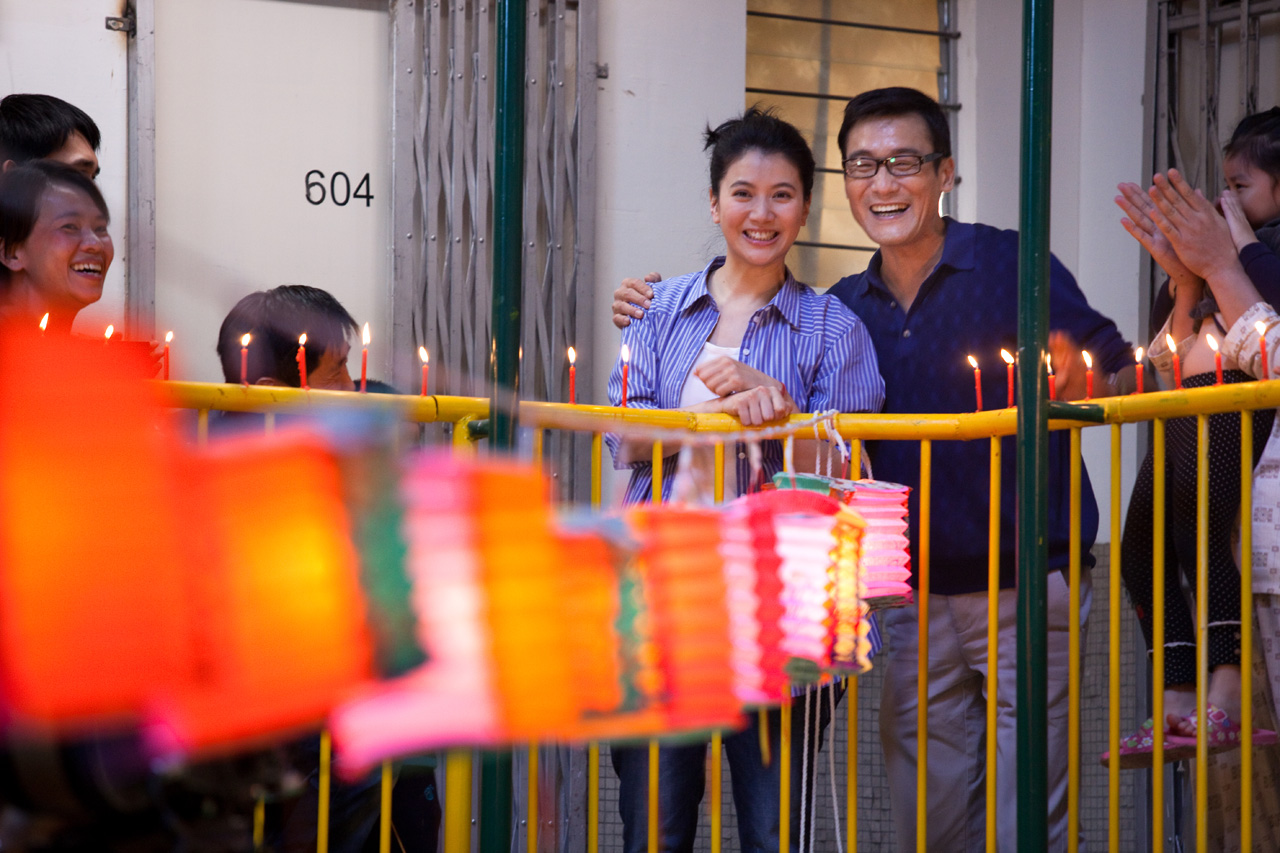
Moreover, I think some of the scenes in the movie not only represented collective memories and the core value of Hong Kong, the scenes also represented a traditional cultural symbol, a ‘Hong Kong thing’: lanterns and candles of the mid-autumn festival. There is a plot showing that Ng and his neighbours of the whole house estate just come out from their home, celebrating the mid-autumn festival at the corridor, they light up lanterns and candles, sing and dance together. You may think it is totally exaggerating for the sing and dance plot, but for me, the scene that the whole estate is full of lighted up lanterns and candles is so touching, I think the celebration is a representation of the Hong Kong uniqueness: 人情味, it is a treasure of Hong Kong- the scene light up audiences’ hearts for being a Hongkonger.


‘I Love Hong Kong’ also spreading some meaningful and impressive messages to audiences. As the whole story takes place in house estate, and we all understand that the house estate is a symbol of ‘grassroot’(草根) , thus. it is no question that the setting of film, the characters etc. would be a kind of ‘grassroot’(草根)- I think the reason that movie chose house estate as a background is to emphasis the contribution of ‘grassroot’Hongkongers: the grassroot’s effort made today’s Hong Kong- everything of Hong Kong today is started at the house estate! Besides, this movie is showing the Hong Kong spirit: in the film, even Ng is bankrupt that changed his and the family living, but all of them never give up, they work hard, and strive for themselves, most importantly. they accepted the change. In my opinion, the messages of the movie are obvious: Hong Kong people can survive from everything, because we never give up, we have faith and courage, we unite to fight got a better tomorrow and a better Hong Kong!

I enjoy this movie very much, it is truly representing a warm story. Yes, it may means it is a commercial movie of TVB, but the messages of ‘I Love Hong Kong’ are very positive for every one, and for me, they are so powerful! Most importantly, the movie made me laugh! That’s comedies are filmed for!!


By Law Siu Ting, Mildred 10382777

Wong Tze Wah Stand up Comedy (黃子華 棟篤笑 娛樂圈血肉史II )


Wong Tze Wah Stand up Comedy was hold on 02 - 09 November, 2010 at Hong Kong Coliseum. It was a solo show which is mainly about his career in the media industry in the past twenty years.

In fact, he had the same show in 1990. Although the formats of the shows are also comedy, the themes of the shows are different. In the 1990 show, he focused on telling audience what is a successful actor. In this show, he expressed his experience in media industry through lots of self-mockery. Although he is failure in being an actor, he is a successful comedian nowadays. Through his performance, he sent a message to the audience that we should not give up our dream easily.

Richard Dyer (1981) argues that a star is someone around which a set of semi-mythological meanings are constructed. Image of a star is constructed by the star himself or the news from media. In the case of Wong Tze Wah, he is not the mainstream artists in Hong Kong. Media are seldom focusing on him. Thus, the image of him is mainly created by his performance. Audience may share an idea that he is a funny guy because on his facial expression or speaking tone in his performance. Also, audience may identify he is a hardworking person when he told his experience in his show. He highlighted the point that he did not give up his dream even he met a lots of setback in his career. Moreover, his previous shows reflected some of the social darkness sides. Audience may agree that his shows are meaningful as it provided a room for audience to reflect themselves. It is mainly because of his personal background. He is a well educated person. He graduated from University of Alberta. And he studied in philosophy. Thus, he always uses some interesting metaphors to explain what he wants to tell the audience. And here’s is the link which was the ending that I watched on 8 November, 2010.

http://www.youtube.com/watch?v=6msbpwl3KG4&feature=related

Because of the audience expectation, some people feel disappointed with his latest show as they think it is not as fun as his previous shows. People assume that his performance should be relating and amusing. However, the latest show is mainly about his struggle in the media industry. Some audience may think the show is boring as it is hard for them to access the experience of an artist. To me, I think the show is excellent as he can use special ways to express a complicated idea to the audience.

Apart from the image of Wong Tze Wah, his show was mainly directed by him. Thus, he is the most affective person in the show. As I mentioned before, using metaphor is one of is characteristics. Also, we may easy discover the character “Ar Keung” in his show because it is another icon in his show.


By Yan Wai Ki (Michelle) 10380469


Shaolin (新少林寺)


The film was a hybrid of an action drama film, narrated a warlord era in China. It was a great visual experience for audiences, which was directed by Benny Chan (陳木勝), starring by Andy Lau (劉德華), Nicholas Tse (謝霆鋒), Jackie Chan (成龍), Fan BingBing (范冰冰) and Wu Jing (吳京).

The narration of this film was about between Chinese people V.S. Western power, and Evilness V.S. Confucianism/Buddhism, which covered a great extent with dominant assumption between Hong Kong and China.

Firstly, Shaolin is a 2011 Hong Kong-Chinese collaboration action film directed by Benny Chan, distributed by Emperor Entertainment Group (英皇集團) and China Film Group Corporation.

Especially now China is one of the most important film markets of Hong Kong films, we need to pay close attention on what ideologies behinds this film and how commercialized films has slowly shift to shared cultural categories between China and Hong Kong.

For instance, Shaolin is a film about a ruthless warlord, Hao Jie (劉德華) understood his own past deed during his stay in Shaolin’s Temple. But even when he was a mean, horrible person, yet, he was still against the idea of doing trade with foreigner (western power requested Hao to unearth Chinese relics, in exchange for advanced weapon for warlord’s wars)

China was overpowered by foreign militaries from 19th century until WWII, it was forced to sign unequal treaties and grant foreigners special privileges of extraterritoriality.

It was a shared historical experience between Hong Kong and China. Hong Kong’s people understood and remembered this history; meanwhile, Chinese people can be more related to this memory, as it was the root of nationalism, a collective identity in China, which glued whole nation together.

And the hidden Nationalism ideologies could please a large heterogeneous audience in China; especially China Film Market is the largest consumption of Hong Kong films.

Furthermore, Hong Kong was once a de-nationalized colony as it was ruled by Britain till 1997. Hong Kong has been caught up in the road which previous dealing with colonialism, post-colonialism, is now re-negotiating with the new discourses of nationalism and patriotism.

The film was co- distributed by China Film Group (CFG). CFG was established in 1949. In 1999, CFG was given a responsibility from Chinese Communist Party (sole government-authorized film distributing company) from manager all overseas distribution to all Chinese-foreign co productions. The differences between Hong Kong and mainland China have been less distinctive.

For instance, half of the main actors were from China, for instance, Wu Jing (吳京), Fan BingBing(范冰) andShi Xiaohong (師小紅). All their characters were strong, positive in Chinese ideologies. All of them fully demonstrated the Confucianism and Buddhism ideologies, from obedience, loving of a wife Fan BingBing, a giving attitude of Buddhism of Wu Jing ( he tried to save all poor civilians that were captured by Cao) and the Confucianism of sworn bother of Hou Jie's Shi Xiaohong (師小紅). ( he saved Hou Jie’s life even after Hao Jie wanted to murder him/捨身成仁).

Furthermore, after the return of HKSAR to China, there are more extensive linkages between Hong Kong and China. By selling a film that was based on shared cultural categories can indeed gain wide profit.

Confucianism is an ideology, which all Chinese people ( Hong Kong and Chinese) understand since they were young. For instance, After the death of Hao’s daughter, the agony had made Hou became disillusioned and depressed, but During his stay in Shaolin, Hou understood Saolin’s principle through study and practiced martial art in order to redeem himself.

Cao Man (謝霆鋒) was an evil warlord that betrayed Hao Jie (劉德華), who killed his daughter. Yet, Hou still wanted to guide Cao back to correct path by using his learned wisdom from Shaolin Temple (以德報怨) .

He defeated Cao in a fight and eventually sacrificed himself to save Cao from being crushed by a falling beam (returning the karma of Song's sacrifice to save Hou during Song's assassination) and fell into the Buddha statue's palm and dies peacefully, leaving Cao feeling guilty.

This film was able to please two film markets with its shared cultural categories (Confucianism and Buddhism) without offending established powers by adding hidden nationalism in it.


By Rebecca, Chen Yi Chen (10465704)

Tuesday, 26 April 2011

《The Miracle Box》


《The Miracle Box》which is shown in 8th April, 2004 and mainly talking about Dr. Tse Yuen Man and her husband Liu Jun Xing love story. Dr. Tse is working and against the SARS epidemic in the front line, unlucky she death at one's post. The film did help to create the noise in the society. This film it represent the video in front of us. It is one of the methods to show.


In this new media era, especially the big changes of the past few years, there are numbers of second hand memories. Some of it is reconstructed by the producer. It may lead to change our memories as well. From the film, we can find out some codes and convention, all of it is make sense for us to watch and understand. For example, when Dr. Tse put on her white overcoat, we must know that she is a doctor.

To me, our roots and routes of cultural identities will change by time to time. Our collective memory which we have experienced and different people will represent in a different way, the point is how we want to represent in front of the others. The collective memory is base on our experience, and our memory is based on our past. Besides, what we choose to remember and tell will depends on different situations.
In 2003, Hong Kong Severe Acute Respiratory Syndrome incident would be every one’s memory. We are afraid and fear as we do not know what to do. The thing we can do is putting on our masks. It is a harsh period for every Hong Kong residents even they are not infected the SARS. We may have different point of view or feelings after watch this film. If you are not in Hong Kong at that period of time, the story is not really close to you and not that meaningful to you. However, if yes, you will have deeply feelings on it as it is collective memory of Hong Kong. The merely difference is that how you decode the message from film. There is a comment about this film, they said that the film is really touching and opened their mind. I think most of Hong Kong resident will share the same feelings.

Aside of, the oral history is also a part of this incident, thus there are some hidden history. Different people will have different version, it is not meaning that they are telling lie. Yet, they have chosen to remember or “delete” a part of the memories. Even we discuss this incident in nowadays, it may have something different.
On the other hand, the society and the industry are affecting to each other. <> is very popular movie and totally representing the SARS incident in 2003, not merely the film industry has produce related film, the music industry has also produce some related songs which we can listen from the film. In nowadays, as a producer, the changes of structure, resource and discourse are still limited, it is constructing by all of us


Yeung Ka Yan Ella (10348676)